CFD of Polymer Flow and Melting in a 3D-Printer Nozzle
I built the ANSYS Fluent pipeline and melting/solidification model to study PLA flow, heating, and nozzle design.
ME 378 · Northwestern University · March 2025
I built the core CFD pipeline and melting/solidification model to study how nozzle geometry and heating affect PLA extrusion, with the goal of reducing extrusion pressure while maintaining suitable flow conditions for printing.
What I built:
- A 2D axisymmetric ANSYS Fluent workflow coupling non-Newtonian flow and heat transfer.
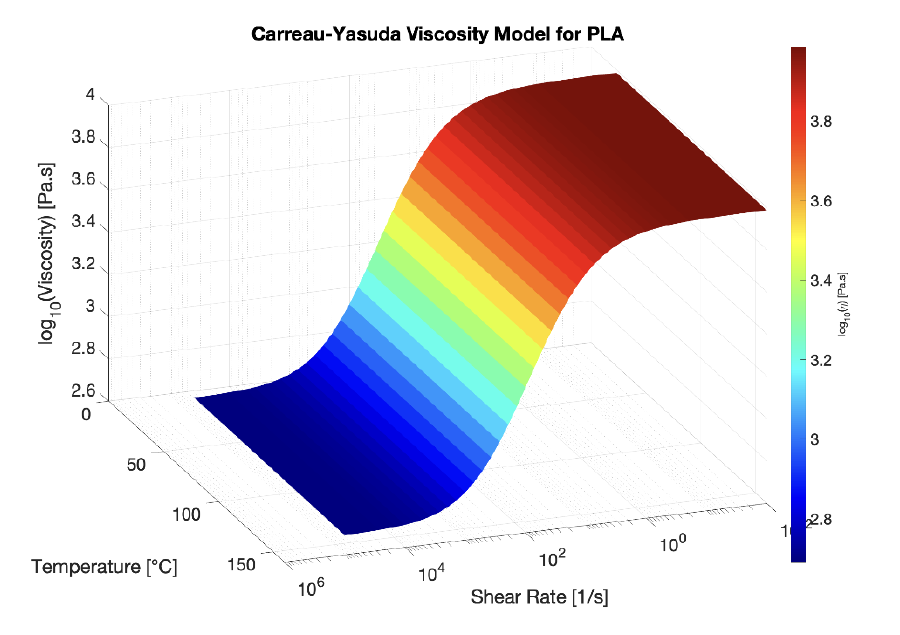
- Viscosity user-defined functions to capture PLA’s temperature and shear-rate dependence.
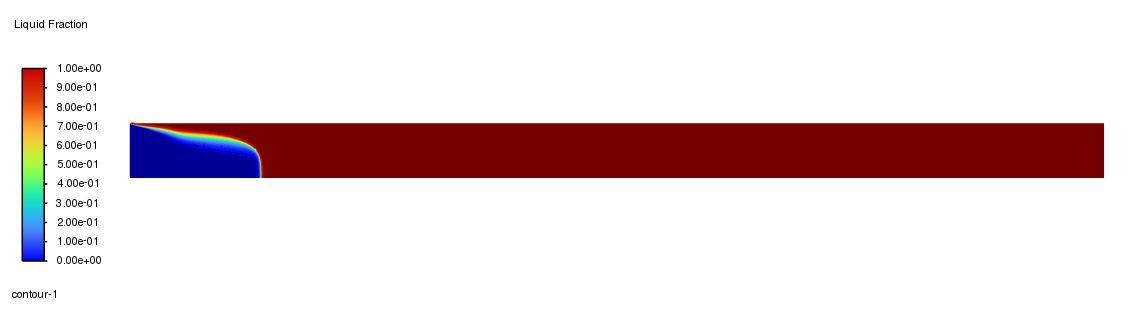
- A melting/solidification model using enthalpy-porosity and temperature-dependent heat capacity to resolve the transition from solid filament to flowing polymer.
Tools: ANSYS Fluent · CFD · viscosity UDFs · enthalpy-porosity modeling
My teammates carried out validation comparisons against published simulations and grid-convergence analysis. My contribution was developing the simulation pipeline and material models used in that work.
Team: Jack Nulisch, Carter Taylor, Garrett Mathesen, and Natasha Van Dam.