Pore Closure in Additively Manufactured Titanium
I independently built an Abaqus model to study how forming closes pores in printed Ti-6Al-4V and how much deformation remains after unloading.
ME/CEE 426, Advanced Finite Elements · Northwestern University · March 2025
Individual project — all modeling, verification, analysis, and reporting by Carter Taylor.
I built a finite element model to investigate whether mechanical forming could close gas pores in directed-energy-deposited Ti-6Al-4V, supporting the development of hybrid additive and forming processes.
What I built:
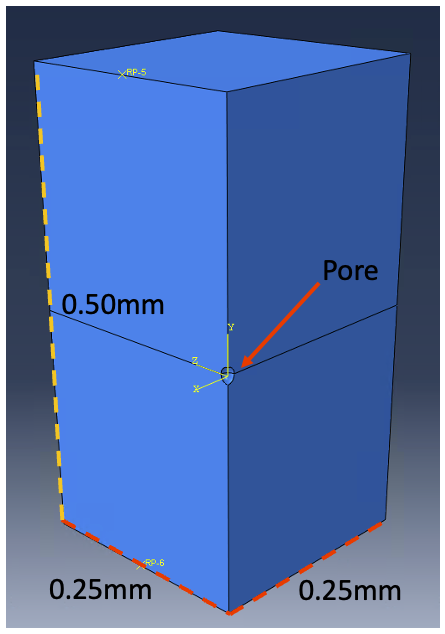
- A quarter-symmetry representative volume element in Abaqus/Explicit, with a spherical pore and Johnson–Cook plasticity.
- Mesh-convergence and energy checks, followed by loading/unloading simulations to measure pore closure and springback.
- Studies of forming depth, temperature, boundary conditions, and ductile damage to assess closure, forming force, and residual stress.
Tools: Abaqus/Explicit · finite element analysis · Johnson–Cook plasticity and damage
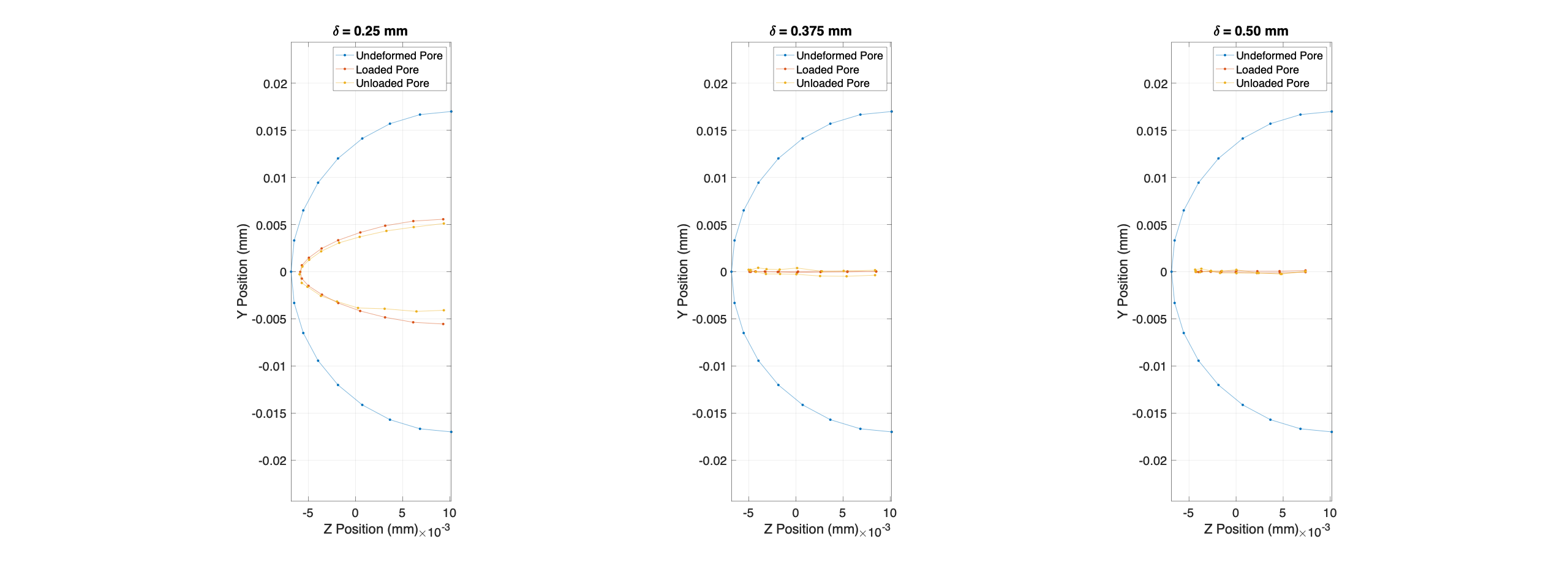
In the room-temperature model, increasing displacement from 0.375 to 0.5 mm required about 18% more force with little additional benefit to pore closure after unloading. These are numerical feasibility results for the modeled geometry and boundary conditions.